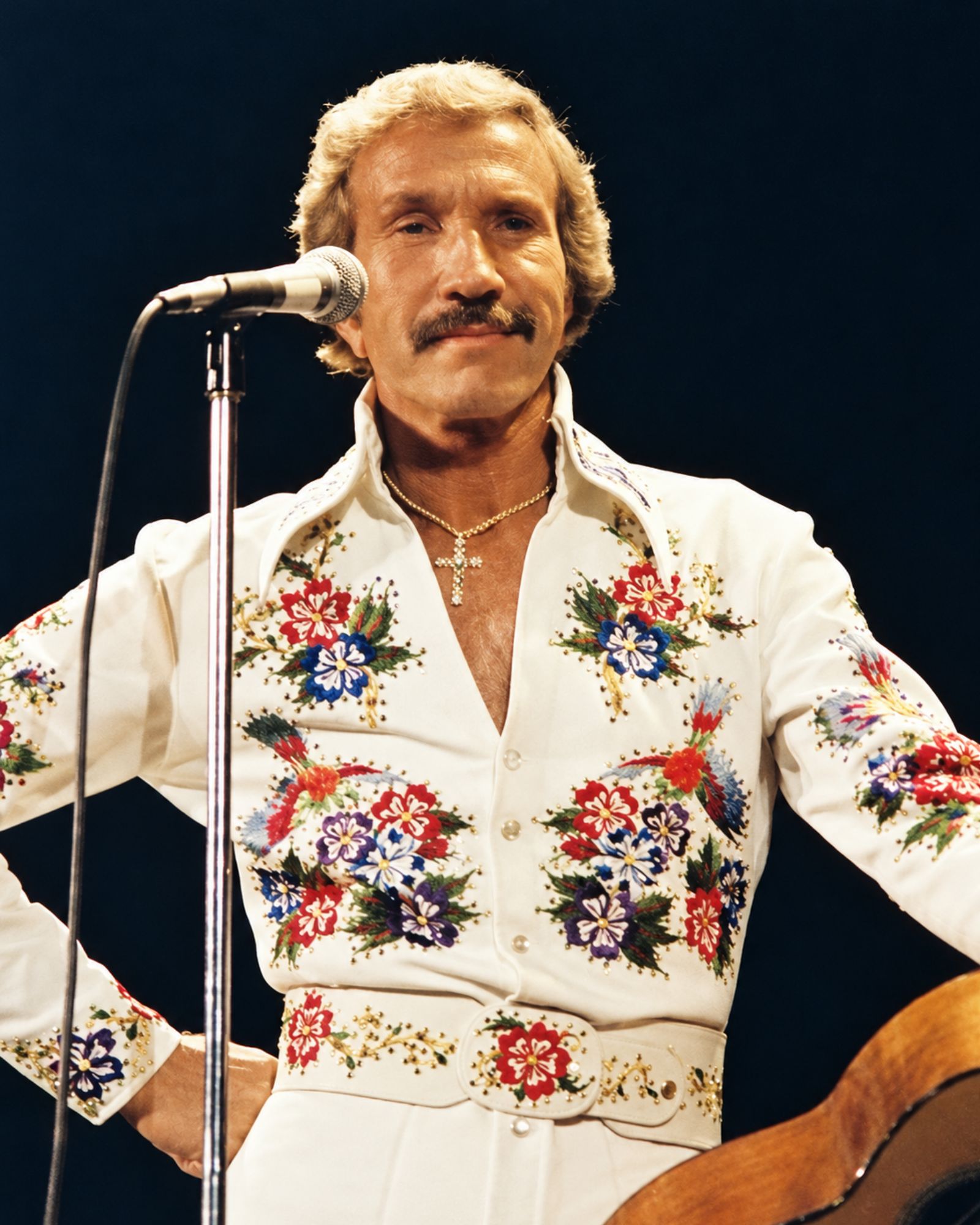
On December 10, 1982, Little Jimmy Dickens walked past the open casket of Marty Robbins at Woodlawn Funeral Home in Nashville and began to cry.
For Little Jimmy Dickens, this was more than the loss of another country music star. More than thirty years earlier, Little Jimmy Dickens had helped an unknown singer from Arizona get a recording contract. That young singer was Marty Robbins.
Now, standing before the casket, Little Jimmy Dickens struggled to hold back the tears.
“I lost a real friend.”
Those five words, reported by United Press International, captured something that a long list of awards and hit records never could.
The Friendship That Started It All
Back in 1951, Marty Robbins was performing on a television program in Phoenix, Arizona, when Little Jimmy Dickens appeared as a guest.
Little Jimmy Dickens recognized something special in the young performer and encouraged Columbia Records to offer Marty Robbins a contract.
That opportunity helped change the course of country music history.
Over the following three decades, Marty Robbins would record unforgettable songs including “El Paso,” “A White Sport Coat (and a Pink Carnation),” “Devil Woman,” and “My Woman, My Woman, My Wife.”
Marty Robbins also became a Grand Ole Opry favorite, a two-time Grammy winner, and a member of the Country Music Hall of Fame.
But on that December afternoon in 1982, Little Jimmy Dickens was remembering a friend, not a collection of achievements.
When Nashville Came to Say Goodbye
On Saturday, December 11, approximately 1,500 mourners gathered for Marty Robbins’s funeral at Woodlawn Funeral Home.
The main chapel could not accommodate everyone. Three additional chapels filled, and mourners stood in the hallways.
Among those attending were Johnny Cash, June Carter Cash, Eddy Arnold, Roy Acuff, Porter Wagoner, Charley Pride, Ricky Skaggs, and Little Jimmy Dickens.
Before the service, recordings of Marty Robbins played softly through the funeral home’s speakers.
Reverend W.C. Lankford delivered the eulogy, remembering how doctors had worked to repair Marty Robbins’s heart and how the singer’s music had comforted countless brokenhearted listeners.
Brenda Lee performed “One Day at a Time.”
The funeral lasted approximately thirty minutes, followed by a private burial.
Only eight weeks earlier, Marty Robbins had been inducted into the Country Music Hall of Fame. Marty Robbins died on December 8, 1982, at just 57 years old.
The Flowers That Revealed Another Side of Marty Robbins
Yet one of the most remarkable parts of the farewell was not a speech or a performance.
It was the flowers.
In the biography Twentieth Century Drifter: The Life of Marty Robbins, author Diane Diekman described elaborate floral arrangements that filled the funeral home.
Behind the casket stood an arrangement shaped like a white sport coat with a pink carnation, a tribute to Marty Robbins’s beloved 1957 recording “A White Sport Coat (and a Pink Carnation).”
Nearby stood a guitar fashioned from brown-colored daisies.
Then there was a tribute from Willie Nelson.
Willie Nelson sent a floral map of Texas made from white carnations. Across the arrangement, the name “El Paso” appeared in gold lettering.
It was a fitting tribute to Marty Robbins’s famous Western ballad, a song that had carried the singer’s storytelling far beyond Nashville.
Another arrangement reflected a passion that some casual listeners never knew about.
Racing legend Bobby Allison sent a checkered NASCAR flag made from black and white carnations.
Marty Robbins was not simply a singer who enjoyed watching automobile races. Marty Robbins competed in NASCAR events and continued racing during the final months of 1982.
Those arrangements represented three different parts of an extraordinary life: the romantic ballads, the Western stories, and the excitement of the racetrack.
A Legacy That Continued Beyond the Funeral
After the service, Marty Robbins was laid to rest at Woodlawn Memorial Park in Nashville.
The crowd eventually dispersed, but the songs remained.
For longtime country fans, “El Paso” could still bring back memories of hearing Marty Robbins on the radio. “A White Sport Coat (and a Pink Carnation)” could recall a younger generation’s dances and romances.
And the tears of Little Jimmy Dickens offered a reminder of the friendships behind the famous records.
Marty Robbins left behind far more than chart successes. The farewell revealed how many different lives Marty Robbins had touched, from fellow singers to racing friends and ordinary listeners.
Perhaps that is why those flowers were so memorable. Each arrangement recalled something real about Marty Robbins, and together they told the story of a life that could never be summed up by a single song.