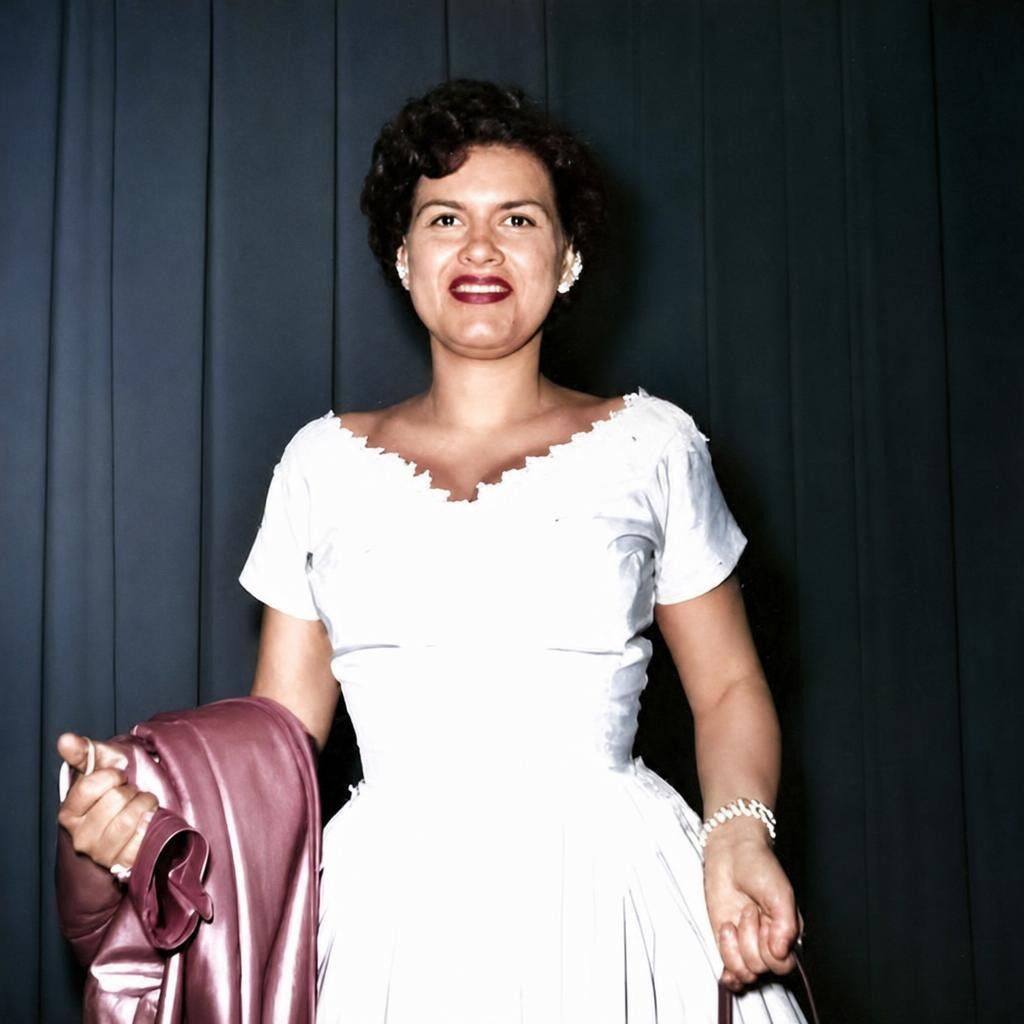
On March 10, 1963, Winchester, Virginia, witnessed a farewell unlike anything the small town had seen before. An estimated 25,000 people lined the five-mile route from Jones Funeral Home to Shenandoah Memorial Park to say goodbye to Patsy Cline.
Some had traveled from Maryland, West Virginia, and Washington, D.C. Others had known Patsy Cline since the days when a young girl named Ginny Hensley was singing at local clubs and radio stations, hoping somebody important might hear her.
Patsy Cline was only 30 years old. And the story behind that enormous farewell began years before the world discovered the voice behind “Crazy.”
Before Nashville, Winchester Had Its Own Star
Born Virginia Patterson Hensley on September 8, 1932, Patsy Cline grew up in a working-class family that struggled financially. At 15, Patsy Cline left school to help support her mother and siblings.
But music remained the dream.
Throughout the late 1940s and 1950s, Patsy Cline performed wherever there was an opportunity: church gatherings, American Legion halls, nightclubs, outdoor venues, and local radio programs. One early job even involved singing from the roof of a refreshment stand at a Virginia drive-in theater.
Those performances rarely brought much money or recognition. But they created something fame could not manufacture: a community of listeners who had watched Patsy Cline grow into an extraordinary performer.
That connection would become especially meaningful in March 1963.
The Concert That Became Patsy Cline’s Last
On March 3, 1963, Patsy Cline traveled to Kansas City, Kansas, for a benefit concert at Soldiers and Sailors Memorial Hall.
The event had been organized to help the family of radio disc jockey “Cactus” Jack Call, who had died in an automobile accident earlier that year.
Several country stars participated, including George Jones, Dottie West, Billy Walker, Cowboy Copas, Hawkshaw Hawkins, and Wilma Lee and Stoney Cooper.
Patsy Cline performed three shows that day, despite feeling unwell. Accounts of the event describe packed audiences and three different stage dresses: light blue, red, and white chiffon.
For the final performance, Patsy Cline closed with “I’ll Sail My Ship Alone,” a song recorded only weeks earlier.
No one in the audience could have known that this would be Patsy Cline’s final public performance.
Two Days Later, Country Music Lost Four Lives
Bad weather delayed the return trip from Kansas City. On March 5, Patsy Cline finally departed aboard a small aircraft piloted by manager Randy Hughes.
Country performers Cowboy Copas and Hawkshaw Hawkins were also passengers.
That evening, the aircraft crashed near Camden, Tennessee. All four people aboard died.
The news stunned the country music community. Patsy Cline had recently reached new levels of success with “I Fall to Pieces,” “Crazy,” and “She’s Got You.” At home, two young children, Julie and Randy, were left without their mother.
Nashville held a memorial prayer service for the victims before Patsy Cline’s remains were returned to Winchester for burial.
The Funeral Home Could Not Hold Everyone
When Patsy Cline came home, the crowds were overwhelming.
According to a later account published in The Washington Post, Jones Funeral Home became so crowded that its doors had to be closed while roughly 1,000 mourners remained outside.
On the day of the funeral, the procession traveled approximately five miles to Shenandoah Memorial Park. People stood along the roadway with bowed heads. Men removed their hats as the hearse passed.
Among those gathered were listeners who remembered the young singer performing for small local audiences long before national success arrived.
The estimated crowd of 25,000 represented more than admiration for a famous recording artist. It reflected years of personal connection between Patsy Cline and the communities where the music career had begun.
The Voice That Continued After the Funeral
Patsy Cline’s recording career was remarkably short, with only three studio albums released during Patsy Cline’s lifetime. Yet the music continued reaching new listeners.
“Leavin’ on Your Mind” and “Sweet Dreams (of You)” both became Top 10 country hits after Patsy Cline’s death.
In 1973, Patsy Cline became the first solo female artist inducted into the Country Music Hall of Fame.
Generations of performers, including Loretta Lynn, Linda Ronstadt, k.d. lang, Trisha Yearwood, and Wynonna Judd, have carried forward elements of Patsy Cline’s influence.
But perhaps the most revealing measure of that legacy remains the funeral in Winchester.
Before the awards, before the lasting reputation, and before the famous recordings became country standards, there were ordinary people who remembered a determined young singer from Virginia.
And on one cold March day in 1963, thousands of them came to say goodbye.