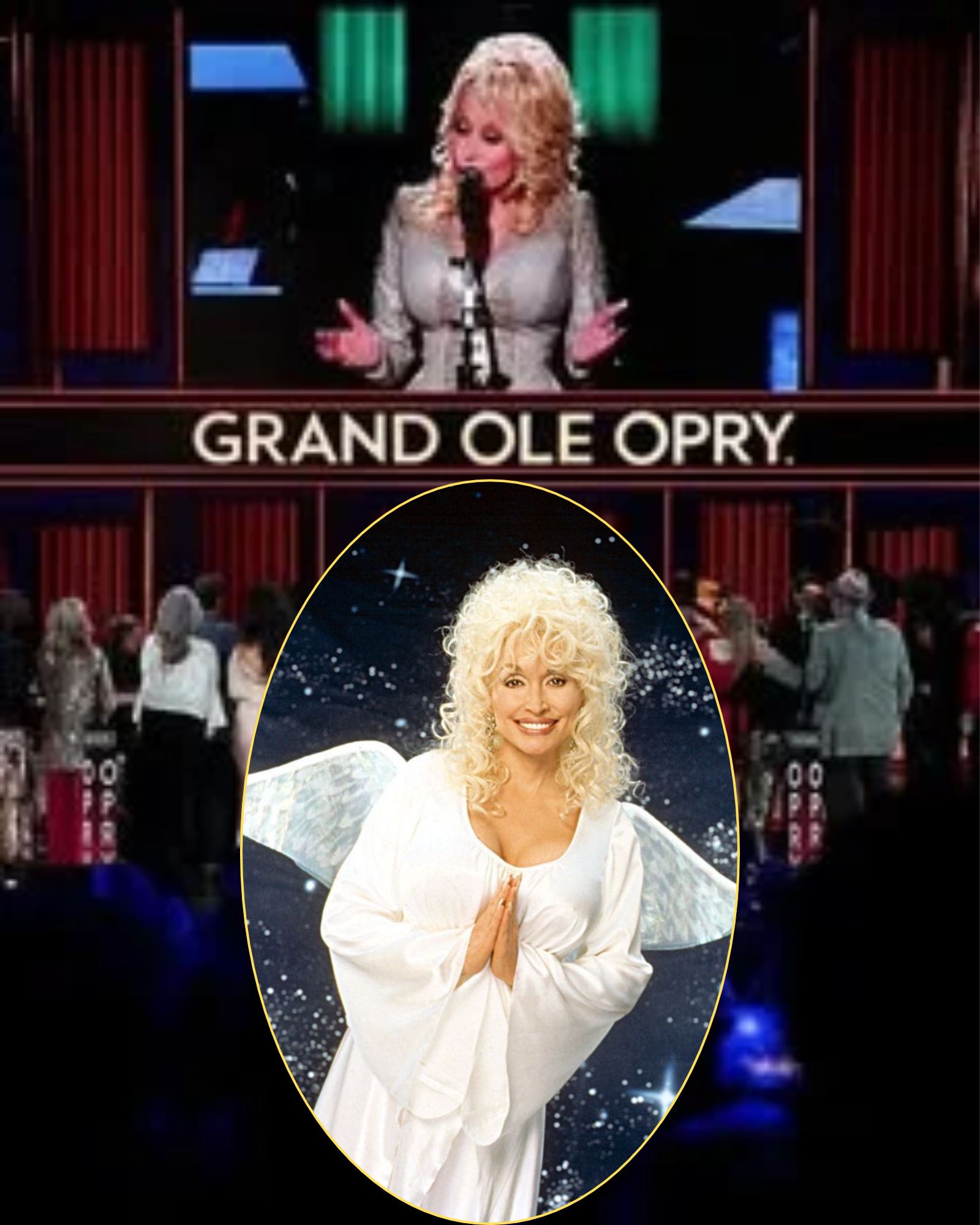
Four days after Dolly Parton passed away, country music stars gathered at the Grand Ole Opry to celebrate a life that had touched generations. Carly Pearce was there. Kathy Mattea was there. Even Jelly Roll made a surprise appearance.
But the most emotional moment of the evening wasn’t a live performance.
It came when the musicians stopped singing, turned toward a screen, and listened to Dolly Parton’s voice fill the Grand Ole Opry one more time.
A Saturday Night Nashville Would Never Forget
On August 29, 2026, the Grand Ole Opry dedicated its Saturday evening performance to Dolly Parton, who had died on August 25 at the age of 80.
The show had originally been scheduled as a celebration of Carly Pearce’s music and five years as an Opry member. But following Dolly Parton’s passing, the evening became something much more personal.
For Carly Pearce, the connection went back years.
Long before Carly Pearce became an award-winning country singer, Carly Pearce worked as a young performer at Dollywood, the Tennessee theme park built around Dolly Parton’s legacy.
In 2021, Dolly Parton personally surprised Carly Pearce with an invitation to become a member of the Grand Ole Opry.
Five years later, Carly Pearce was standing on that same famous stage, honoring the woman who had helped make that dream possible.
The Songs That Brought Dolly Parton’s Story Back to Life
The evening featured performances from artists representing different generations of country music.
Carly Pearce opened with “Those Memories of You,” a song associated with the legendary Trio recordings of Dolly Parton, Linda Ronstadt, and Emmylou Harris.
Kathy Mattea performed “Jolene,” while Ketch Secor and Molly Tuttle joined together for “Just Someone I Used to Know.”
Channing Wilson honored Dolly Parton’s Tennessee roots with “My Tennessee Mountain Home.”
One particularly personal moment came when Dolly Parton’s niece, Jada Star, performed “The Orchard,” a song connected to the Parton family’s musical heritage.
These weren’t simply covers of familiar country hits. Each performance offered a reminder of another chapter in Dolly Parton’s extraordinary journey.
And throughout the evening, archival footage reminded the audience of Dolly Parton’s long relationship with the Grand Ole Opry.
Then Jelly Roll Walked Onto the Stage
As the tribute approached its finale, Carly Pearce began performing “9 to 5,” one of Dolly Parton’s most recognizable songs.
Then came an unexpected guest.
Jelly Roll joined Carly Pearce onstage, bringing another generation of country music into the celebration.
Other performers returned to the stage, joining in the lively finale as the audience celebrated a song that had become part of American musical history.
For a moment, it seemed like the perfect way to close the evening.
But the Grand Ole Opry had saved something special for last.
One Last Song From Dolly Parton Herself
After “9 to 5” ended, the performers remained together onstage.
Instead of beginning another song, the musicians turned toward a screen displaying archival footage of Dolly Parton performing at the Grand Ole Opry.
Then Dolly Parton’s unmistakable voice began singing “I Will Always Love You.”
The recording brought the evening back to the artist everyone had gathered to remember.
There was something especially meaningful about the choice.
Dolly Parton originally wrote “I Will Always Love You” in the early 1970s while preparing to leave a professional partnership with Porter Wagoner. The song expressed gratitude, affection, and the difficulty of saying goodbye.
More than five decades later, those same sentiments seemed to carry an entirely different meaning.
The Grand Ole Opry had first welcomed Dolly Parton onto its stage in 1959, when Dolly Parton was just 13 years old.
Now, in August 2026, the artists who had grown up admiring Dolly Parton stood together watching that familiar face and listening to that familiar voice.
The audience rose for the farewell.
A Farewell That Only Dolly Parton Could Deliver
Throughout the evening, country music’s younger and older generations had honored Dolly Parton with performances, memories, and songs.
Yet the final performance belonged to Dolly Parton.
Not through a new recording or an unexpected appearance, but through a preserved moment from the same stage that had been part of Dolly Parton’s life since childhood.
It was a fitting conclusion to a remarkable evening: a room filled with people who loved Dolly Parton’s music, listening as Dolly Parton sang a song about enduring love and goodbye.
And for countless country music fans, “I Will Always Love You” may never sound quite the same again.
Do you remember the first time you heard Dolly Parton sing “I Will Always Love You”? Was it Dolly Parton’s original recording, or did you discover the song years later?