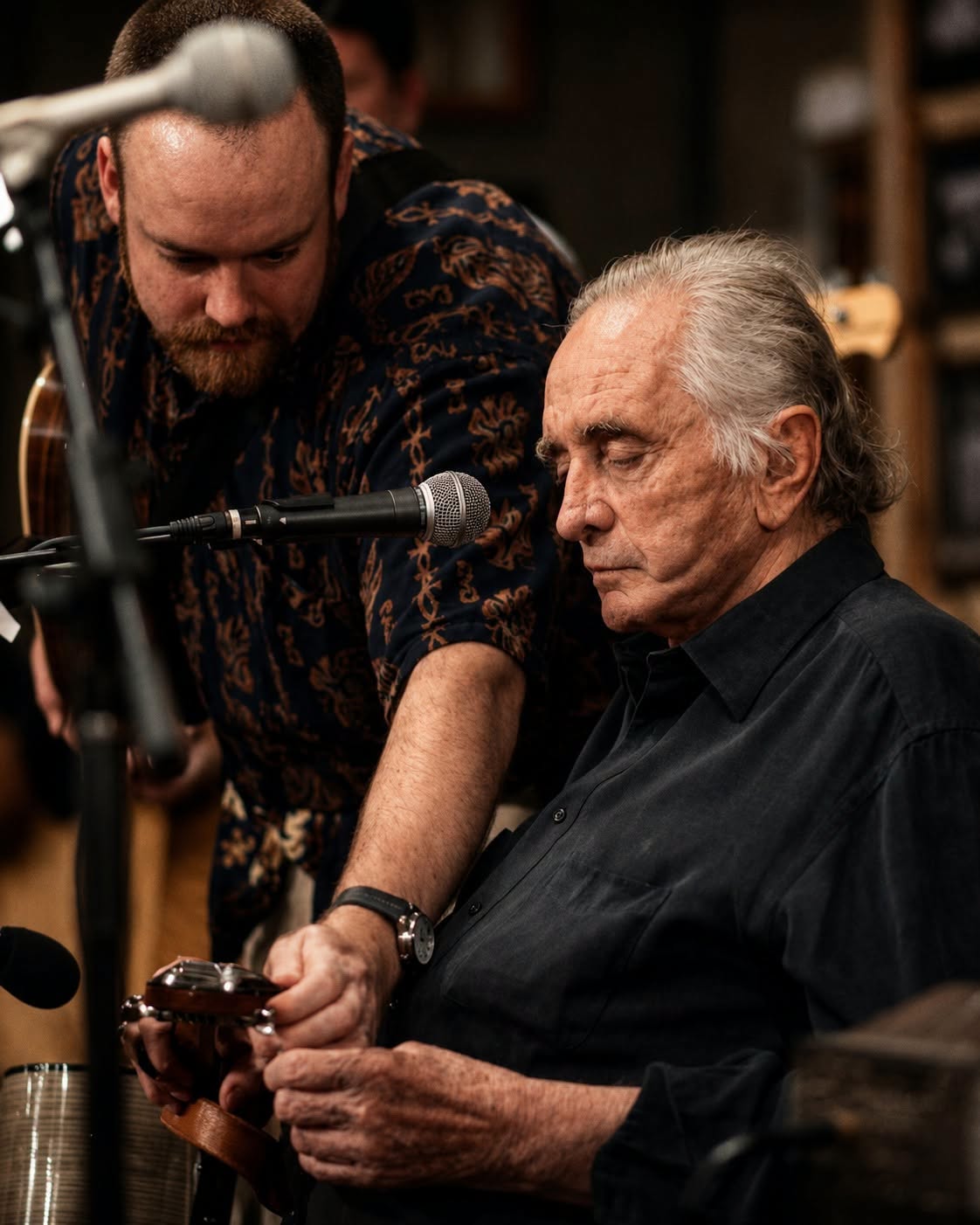
Johnny Cash Kept Singing After June Carter Cash Died
When June Carter Cash died on May 15, 2003, Johnny Cash was already living with serious health problems. He was weak, often confined to a wheelchair, and dealing with blindness in one eye. But grief gave the situation a new edge. The woman who had stood beside him for decades was gone, and the silence left behind was too heavy for him to carry alone.
So Johnny Cash went back to work.
He told producer Rick Rubin that he needed to keep recording. Not because it was easy. Not because he was feeling strong. He said that without something to do, he felt he would die. That was the truth at the center of those final months: music was not a luxury for Johnny Cash. It was a reason to get up, a structure to hold onto, a way to move through the day.
Whenever Johnny Cash had enough strength, the microphones came back on. He sang gospel songs, old standards, and newer material with the same weathered voice that had carried him through a lifetime of loss, redemption, and return. In those sessions, about sixty performances were captured in roughly four months. That number matters, but only because it shows how hard Johnny Cash kept pushing forward.
The Last Public Moment
On July 5, 2003, Johnny Cash made what would become his final public appearance at the Carter Family Fold in Virginia. Before singing “Ring of Fire,” Johnny Cash spoke about June Carter Cash and said he still felt her presence around him. It was a quiet moment, but an unforgettable one. There was no grand speech, no performance of strength for its own sake. There was only a man standing in the space his wife had once shared, trying to sing through the ache.
Sixty-nine days later, Johnny Cash was gone.
He died on September 12, 2003, less than four months after June Carter Cash. The timing feels almost too close to bear, as if one life had been holding on long enough to follow the other. But the recordings tell a different story. Johnny Cash did not spend those weeks waiting for the end. He spent them working, breathing, remembering, and singing.
What Was Left Behind
The songs from that period did not disappear with him. They continued to gather meaning after his death, especially when American V: A Hundred Highways arrived in 2006. The album became Johnny Cash’s first No. 1 on the Billboard 200 since 1969, a late landmark that showed how deeply those final sessions still resonated.
Johnny Cash did not stop creating when life became hardest. He kept going because music gave him something grief could not take away.
That is why the final recordings matter so much. They are not only the sound of decline. They are the sound of endurance. They carry the weight of loss, but they also carry devotion, discipline, and love.
Some artists leave behind a final chapter that feels unfinished. Johnny Cash left behind something more human than that. He left proof that even in pain, even after goodbye, he still chose to sing.