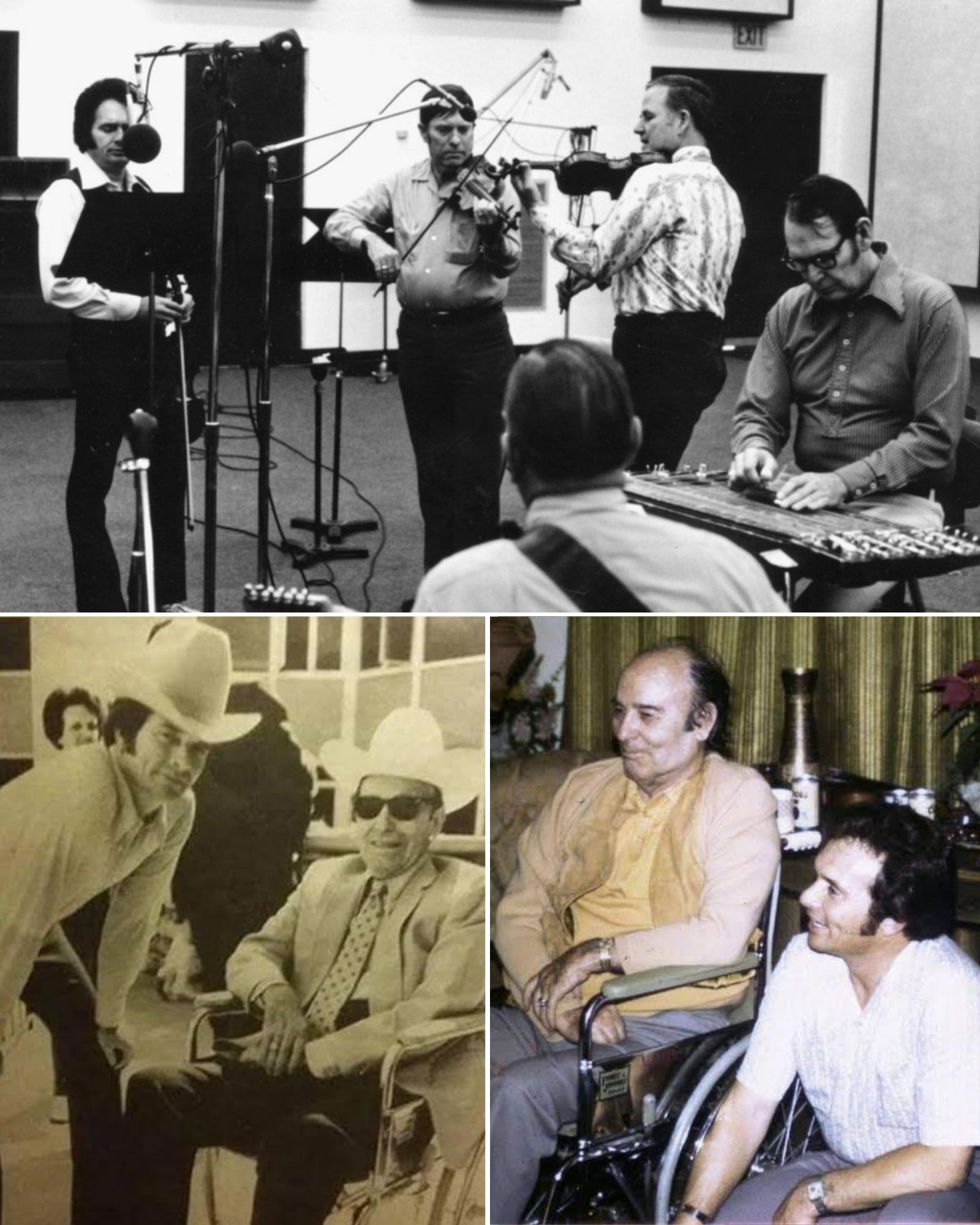
By September 1971, Bob Wills had lost the thing that made him Bob Wills. A series of strokes had left his right hand paralyzed. The bow arm that once filled dance halls across Texas, Oklahoma and California could no longer draw a single note.
And yet, on a fall day at Merle Haggard’s ranch in Bakersfield, California, Bob Wills asked for his fiddle.
A reunion with a secret
Merle Haggard had grown up on Bob Wills. In the California valley where Merle was raised, Bob Wills records played on the radio several times a day, and to the Okie families who had moved west, meeting Bob Wills would have felt bigger than meeting the president. A year earlier, Merle had recorded a whole tribute album to him, choosing the musicians on Bob’s own advice while Bob lay in a Fort Worth hospital bed.
Now Merle wanted something more personal. He arranged for Bob to come stay at his ranch. Then he invited a large group of surviving Texas Playboys, and he did not tell them who else would be there.
They came from all over. Johnny Gimble, Eldon Shamblin, Tiny Moore, Joe Holley, Alex Brashear and Bob’s brother Johnnie Lee Wills, the men who had played on Merle’s tribute album. Leon McAuliffe on steel guitar. Al Stricklin on piano. Smokey Dacus on drums. Bob’s brother Luke Wills on bass. Tommy Duncan, the band’s great singer, had died in 1967, so his brother Glynn Duncan stepped in to sing.
Al Stricklin later told Bob’s biographer Charles Townsend that without Merle, some of these men would never have seen each other again. Stricklin himself had not seen some of the boys in thirty years. The last time he had seen trumpet player Alex Brashear, the man’s mustache was still brown. Now it was gray.
When they arrived, they found their old boss waiting for them.
The white hat, the boots and the fiddle
Bob Wills had stayed in bed since he got to the ranch. But when the band set up by the swimming pool and started to play, he would not stay in that bed.
He had his wife, Betty, dress him in his white hat and his cowboy boots. Then he was taken out in a wheelchair to the pool area where the men were recording. Once he was there, he asked Betty for one more thing: his fiddle.
He could not play it. Everyone there knew it. Bob Wills sat in front of the band anyway, holding the instrument, and led them the way he had led them for decades, with his presence alone. Several of the musicians said that simply having him there made them play better.
For a few hours, the man who had been nearly forgotten by the music business was back where he belonged, at the front of the Texas Playboys.
What the tape machines caught
This was not just a party. Capitol Records producer Ken Nelson brought the label’s remote recording truck to the ranch, and the band cut nearly twenty songs.
Merle suggested they open with “Osage Stomp,” a tune Bob had recorded at his very first session back in 1935. From there they ran through the songs Bob’s fans knew by heart, including “Faded Love,” “Steel Guitar Rag,” “Sittin’ on Top of the World” and “Misery,” before closing with “Sugar Moon.”
“It lacks only one thing”
According to Charles Townsend’s biography of Bob Wills, Merle walked over at one point and asked his hero how it sounded. Bob’s answer said everything about what he had lost.
“It lacks only one thing.” “What’s that?” “Me.”
The music was still alive inside him. His body simply would not let it out.
The tapes nobody heard
The recordings from Merle Haggard’s ranch stayed unreleased for decades. Fans were told the tapes were not good enough technically. The truer answer, as historian Deke Dickerson put it in his liner notes for Hag: The Capitol Recordings 1968–1976, is that Merle did this one for himself. The session finally came out years later on Bear Family’s Faded Love box set of Bob Wills recordings, a good if imperfect record of a day that mattered.
Bob Wills would later give Merle Haggard one of his prized fiddles. In December 1973 he led one final reunion session in Dallas from his wheelchair, then suffered a massive stroke that night and never regained consciousness. He died on May 13, 1975.
But in September 1971, beside a swimming pool in Bakersfield, Bob Wills put on his white hat, held his fiddle, and stood in front of his band one more time. Merle Haggard made sure of that.
Did you grow up with Bob Wills on the radio? Which of his songs still takes you back?