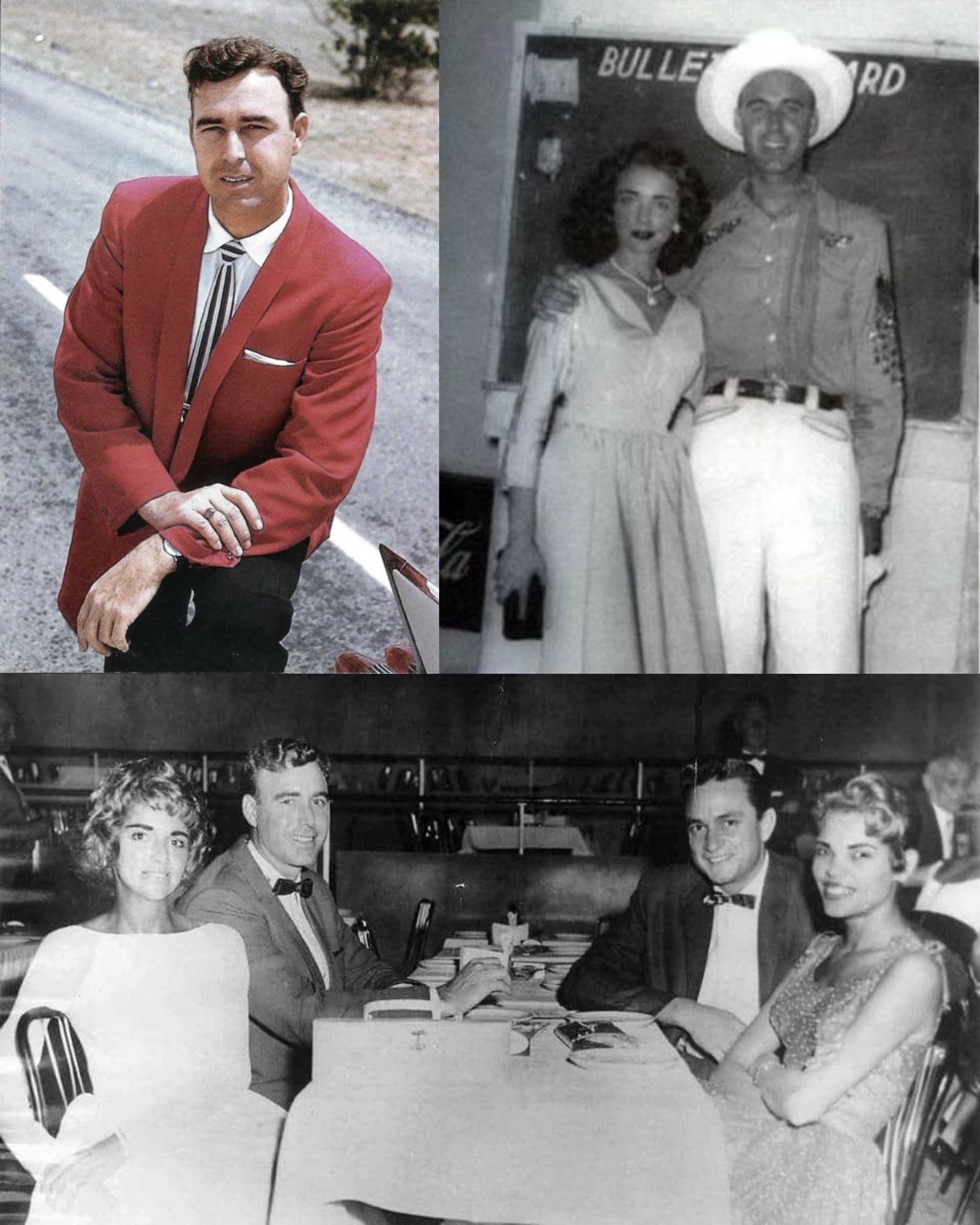
On the night of November 4, 1960, Johnny Horton stayed in the dressing room at the Skyline Club in Austin, Texas, between his sets. He would not walk out into the bar. For years he had been telling the people closest to him that he would one day be killed by a drunk, and that night the fear seemed to sit heavier than ever.
He had reason to feel uneasy about that particular room. Eight years earlier, Hank Williams had played his last public show on the same stage. And the woman waiting for Johnny at home in Shreveport, Billie Jean, had been Hank’s wife when he died.
A Stage Hank Williams Had Already Said Goodbye On
The Skyline Club sat on what was then the Dallas Highway, a few miles north of Austin, on the road now called North Lamar Boulevard. Almost every big name of the era passed through it. On December 19, 1952, Hank Williams played there. About two weeks later, on New Year’s morning 1953, he was found dead in the back seat of his Cadillac on the way to a show in Ohio. He was 29.
Johnny Horton had known Hank through the Louisiana Hayride in Shreveport. In September 1953, nine months after Hank’s death, Johnny married Billie Jean. He was still a struggling singer then, and for a while the couple lived largely on her settlement from the Williams estate.
By 1960 that had changed completely. “The Battle of New Orleans” had topped both the country and pop charts in 1959 and won him a Grammy. “Sink the Bismarck” followed. His newest single, “North to Alaska,” was the title song of a John Wayne picture, sung over the opening credits.
The Show He Did Not Want to Play
Horton had other places he could have been that weekend. He had been invited to the premiere of North to Alaska and to a disc jockey convention in Nashville. According to an account built largely on the recollections of his manager and bass player, Tillman Franks, the Skyline date was booked only four days earlier because Johnny needed money. He disliked playing rooms that served whiskey and beer, and Franks promised him this would be the last time.
Franks was recovering from surgery and his wife had begged him to stay home. Johnny talked him into coming anyway. On the drive down, they stopped in Rusk, Texas, so Johnny could visit his mother. Because of Franks’ condition, a local bass player sat in for the show. Johnny played three short sets, and by every account the night went smoothly.
The Drive Home
As soon as the show ended, Johnny wanted to leave. It was a five-and-a-half-hour drive back to Shreveport, and duck season opened in the morning. He had plans to go out with his friend, the singer Claude King.
The equipment went into the trunk of his Cadillac. Franks took the front passenger seat. Guitarist Tommy Tomlinson rode in the back. They stopped for coffee in Round Rock and then headed east on Highway 79. Franks later recalled that Tomlinson grew nervous about how fast they were going. Johnny answered with a line from one of his own early records.
“Don’t worry, I’m doggin’ it in.”
The Bridge at Milano
Around 1:30 in the morning on November 5, the Cadillac reached the small town of Milano and started across a concrete bridge over the railroad tracks. A pickup truck coming the other way struck the side of the bridge, careened across the road and hit them head on. Franks, who had dozed off leaning against Johnny, woke as Johnny jerked the wheel trying to get clear.
The other driver was James Evan Davis, a 19-year-old Texas A&M student who had been drinking. He suffered only minor injuries. Johnny Horton was still alive when help arrived, but he died on the way to the hospital in Cameron. He was 35. Franks suffered head injuries. Tomlinson’s leg was so badly broken that it was later amputated.
Johnny Horton never drank. The fear he had carried into the Skyline Club that night had come true about 55 miles down the road.
A Widow Twice Before Thirty
Billie Jean Horton was 27. In a little under eight years she had lost two husbands, both country stars, both in Cadillacs, both after final shows at the same Austin nightclub. She was left with three young children to raise. In the years that followed she fought hard, and mostly successfully, in court over her name and the royalties tied to both men.
Davis was later convicted and given probation. Accounts differ on the exact sentence.
On January 9, 1961, about two months after the crash, “North to Alaska” reached No. 1 on the Billboard country chart. It stayed there for five weeks and climbed to No. 4 on the pop chart. Johnny Horton is buried near Shreveport, in Haughton, Louisiana.
What Is Documented and What Is Legend
The core facts are solid: the last show at the Skyline Club, the marriage to Hank Williams’ widow, the drunk driver on the Milano bridge and the posthumous No. 1. His fear of dying at the hands of a drunk was described by his manager and by several people who knew him.
Other details have grown with the retelling. One story says Johnny kissed Billie Jean goodbye in the same spot, on the same cheek, where Hank once had. Another says Johnny was driving through Milano when he first heard on the radio that Hank had died. A third holds that Johnny Cash, struggling with pills at the time, did not take Johnny’s phone call that morning and regretted it for the rest of his life. These come from later accounts and cannot be fully confirmed.