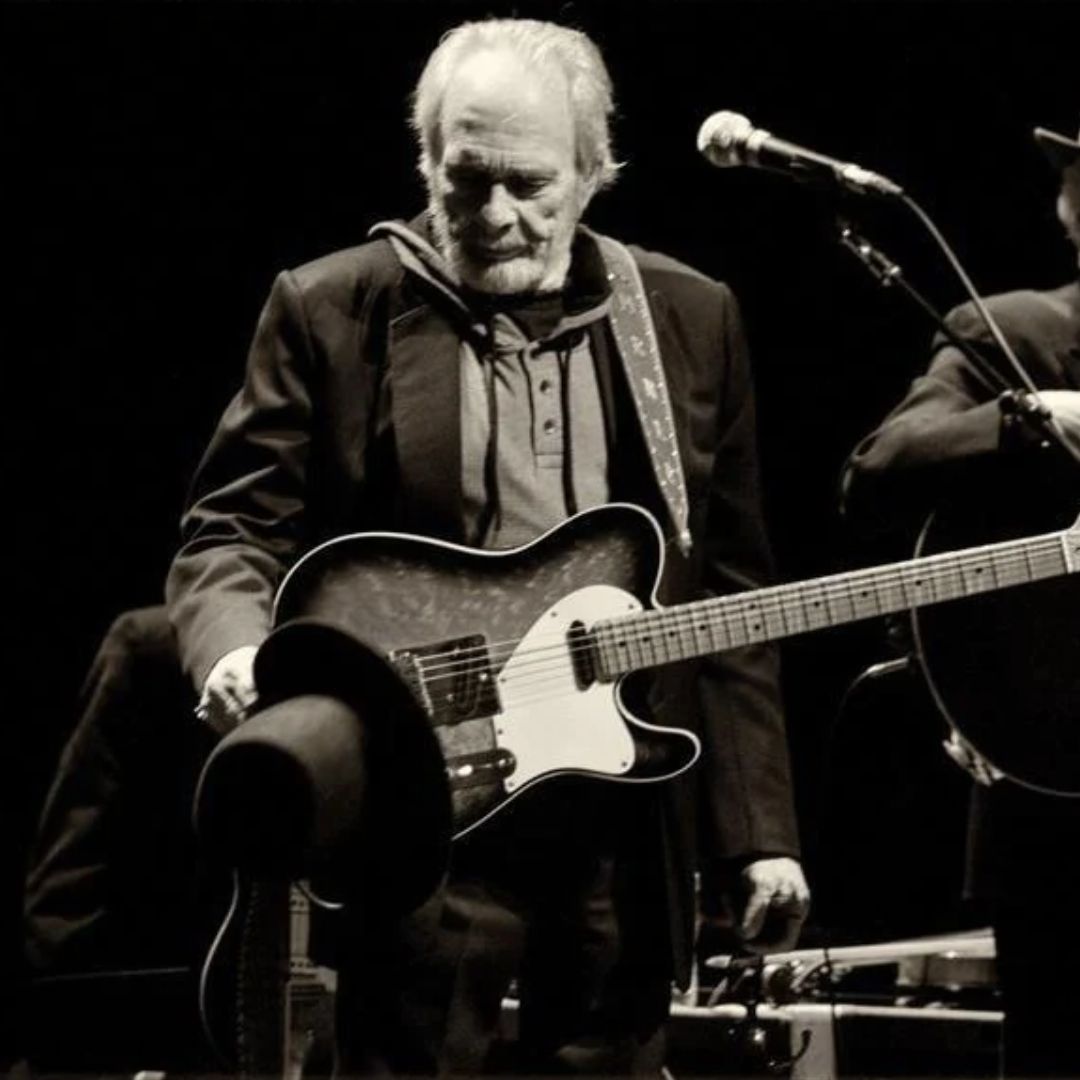
On February 13, 2016, Merle Haggard removed his cowboy hat and acknowledged a standing ovation at Oakland’s Paramount Theatre. To the people applauding, it seemed like the familiar ending to another evening with one of country music’s greatest voices.
But that night would become Merle Haggard’s last known public concert.
One woman in the audience, Jill Fordyce, later recalled that even though Merle Haggard appeared weaker than usual, she fully expected to see the singer performing again that summer.
Fifty-three days later, on April 6, 2016, Merle Haggard died on his 79th birthday.
A Saturday Night in Oakland
The concert had originally been scheduled for December 2015 but was postponed after Merle Haggard developed double pneumonia. By February, Merle Haggard was back onstage, determined to continue doing what had defined much of his life.
The historic Paramount Theatre was filled with enthusiastic fans. Some had followed Merle Haggard for decades, while others belonged to a younger generation discovering the music.
Noel Haggard opened the evening with The Strangers, the band that had accompanied Merle Haggard through so many years of performances.
When Merle Haggard finally appeared, dressed in dark clothing, sunglasses, and a cowboy hat, the audience greeted the country legend with a standing ovation.
Merle Haggard picked up a Martin guitar and began with “Big City.”
Soon came familiar songs including “Silver Wings,” “Mama Tried,” and “Sing Me Back Home.” These were songs that generations of country fans knew by heart, but hearing them that February evening would later carry a different meaning.
A Father Watching His Son Play Guitar
One of the evening’s most memorable moments had little to do with Merle Haggard’s own singing.
Ben Haggard, Merle Haggard’s youngest son, was playing lead guitar with The Strangers. At just 17 years old, Ben had already earned a place beside musicians who had spent years performing with his father.
Jill Fordyce later described watching Merle Haggard turn toward Ben during a guitar solo.
Rather than facing the audience, Merle Haggard watched Ben play, remaining focused on the performance until the solo ended.
It was a small moment between father and son, but one that Fordyce remembered long afterward.
For fans who had followed Merle Haggard’s career from the Bakersfield years, seeing the next generation carrying the music forward added something special to the evening.
The Song One Woman Never Forgot
Merle Haggard spoke openly about recovering from pneumonia and acknowledged having difficulty catching a breath at times. The band sometimes extended musical passages, giving the singer additional space between songs.
Yet the evening was not simply a struggle through illness. Merle Haggard joked with the audience, played fiddle, and continued delivering songs with the unmistakable style that had made the singer a country legend.
For Jill Fordyce, one performance stood above the others.
It was “If I Could Only Fly,” written by Texas songwriter Blaze Foley.
The song tells of distance, longing, and the desire to be near someone loved. As Merle Haggard sang, Fordyce remembered the audience and musicians becoming quiet, their attention centered on the words.
She had heard Merle Haggard perform many times before. But that particular rendition remained with her.
What makes her account especially moving is that Fordyce did not recognize the evening as a farewell. Despite the signs of illness, she believed Merle Haggard would recover, return to the tour bus, and continue performing.
The Last Tip of the Cowboy Hat
Merle Haggard also performed “Okie from Muskogee,” drawing familiar reactions from the Bay Area audience when the song mentioned hippies in San Francisco.
The show retained touches of the humor and musicianship that longtime fans expected. When Merle Haggard introduced The Strangers, the musicians playfully shook hands with one another.
And when the performance ended, Merle Haggard removed the cowboy hat and acknowledged the audience standing in appreciation.
There was no announced retirement, no prepared farewell speech, and no public declaration that this would be the final concert.
Merle Haggard still hoped to perform again. Additional concerts were planned, but none would follow.
After Merle Haggard’s death, Jill Fordyce revisited the words of “When My Last Song Is Sung,” another Haggard composition. The song offered a way to reflect on that February night, even though it was not part of the documented performance.
Today, the Oakland concert stands as a final chapter in a remarkable performing career.
Merle Haggard gave the audience familiar songs, watched Ben Haggard play guitar, and ended the evening with a simple gesture of thanks.
For the people inside the Paramount Theatre, it was another Saturday night listening to Merle Haggard.
Only later would they understand that they had witnessed the last one.