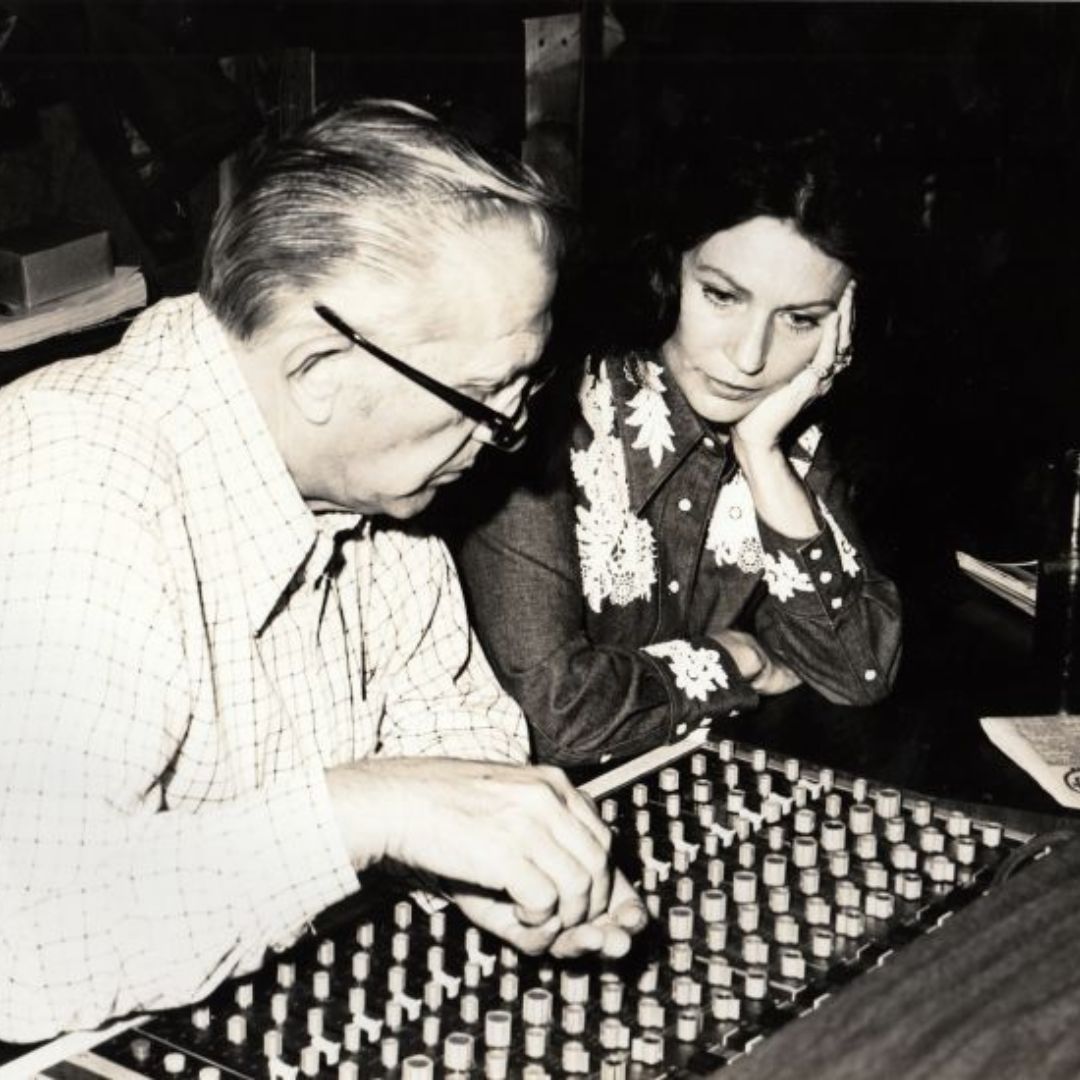
In October 1969, Loretta Lynn walked into a recording studio in Mount Juliet, Tennessee, to record a song about growing up in a poor coal-mining family in Kentucky. By the time the musicians finished playing, nearly everything was in place.
But when Loretta Lynn listened to the recording, something bothered her.
She had forgotten one little word.
It was only “yeah,” meant to come just before the proud declaration in the song’s final chorus. Yet Loretta Lynn wanted that word in the recording, and what happened next became one of the most charming stories behind her signature hit.
Inside Bradley’s Barn in 1969
The recording took place at Bradley’s Barn, the studio operated by legendary Nashville producer Owen Bradley. Loretta Lynn had worked with Owen Bradley for years, and their partnership helped establish her unmistakable sound.
The musicians assembled for “Coal Miner’s Daughter” included some of Nashville’s most respected players. Buddy Harman handled the drums, Hargus “Pig” Robbins played piano, and Bob Moore played bass. Guitarists Harold Bradley, Grady Martin, and Ray Edenton were also part of the session, along with the Jordanaires providing background vocals.
Recording engineer Jim Williamson later described the studio arrangement in remarkable detail.
The musicians were positioned around the room, with the drums near the center, piano and bass nearby, and guitars occupying other sections. Loretta Lynn sang alongside the musicians rather than recording an entirely separate lead vocal afterward.
Much of the song was captured live, giving the performance the natural, conversational quality listeners still recognize.
The Missing Word That Made Loretta Lynn Stop
After recording the song, Loretta Lynn entered the control room to hear the playback.
According to Jim Williamson, she immediately realized that she had forgotten to sing “yeah” before the final chorus.
Jim Williamson suggested a simple solution: Loretta Lynn could return to the microphone and record that one word without repeating the entire performance.
Loretta Lynn was surprised.
“You can do that?”
That was the question Jim Williamson remembered Loretta Lynn asking, as recounted in a 2008 interview with Mix magazine.
Using an available track on the recording equipment, Jim Williamson played the song back and guided Loretta Lynn to the precise moment where the missing word belonged.
Loretta Lynn sang “yeah,” and the addition was complete.
There was no need to gather the entire band for another performance. One word had been added to the recording, exactly where Loretta Lynn wanted it.
Jim Williamson later recalled that this was the only vocal overdub he remembered making for the song.
The Verses That Never Made the Record
The missing word was not the only interesting detail about the recording.
Loretta Lynn originally wrote a much longer version of “Coal Miner’s Daughter.” Before the song was recorded, several verses were removed to make the performance more suitable for a commercial single.
Among the omitted memories was a verse describing Loretta Lynn’s mother decorating their home with magazine pictures of Hollywood actresses.
In a 2000 NPR interview, Loretta Lynn explained that her mother had admired actresses including Loretta Young and had chosen her daughter’s name after seeing Loretta Young’s picture.
Other removed material concerned flooding near the family home and the annual preparation of meat for Christmas.
Those memories never appeared in the familiar recording, but they reveal how much of her childhood Loretta Lynn originally wanted to preserve.
From a Personal Memory to a Country Music Classic
Despite the careful work that went into recording “Coal Miner’s Daughter,” Loretta Lynn was uncertain whether listeners would be interested in a song about her own childhood.
The recording remained unreleased for nearly a year before Decca issued it as a single in 1970.
It reached No. 1 on Billboard’s country chart and eventually inspired Loretta Lynn’s autobiography and the celebrated 1980 film starring Sissy Spacek.
Yet the story of that missing word offers something the chart positions cannot.
It captures Loretta Lynn in the studio, paying attention to a tiny detail in a song that told her family’s story.
The next time “Coal Miner’s Daughter” plays, listen for that little “yeah” near the end.
It is easy to miss. But thanks to Loretta Lynn and Jim Williamson, it became part of one of country music’s most beloved recordings.