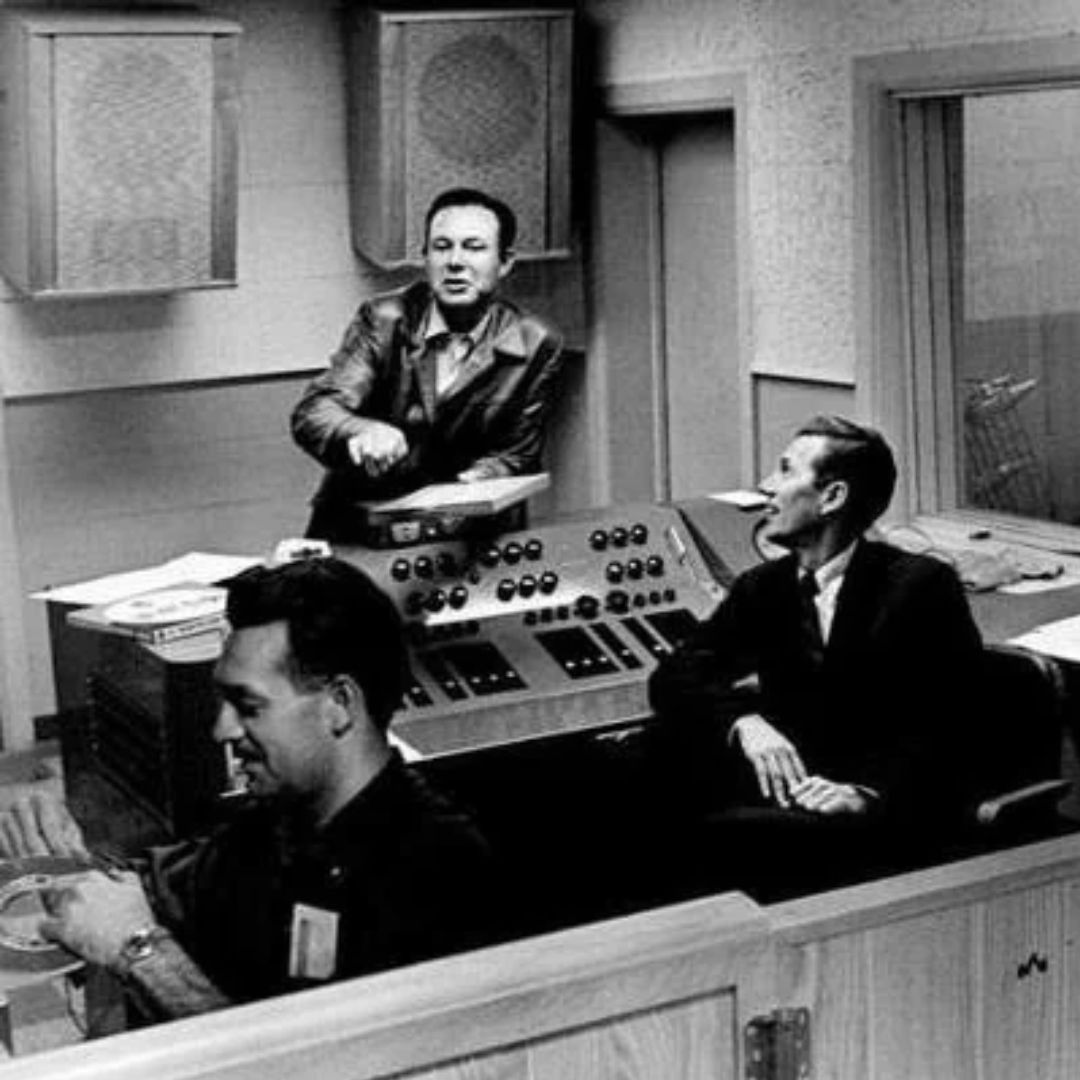
Chet Atkins had planned to produce the recording session from the control room. Jim Reeves had something else in mind.
On February 7, 1957, Jim Reeves arrived at RCA’s recording facility on McGavock Street in Nashville to record a song called “Four Walls.” Chet Atkins was producing, but Jim Reeves wanted more than the producer’s guidance. Jim Reeves wanted Chet Atkins playing guitar on the record.
That request would make the session unusually demanding for Chet Atkins. It would also help produce one of the most important recordings of Jim Reeves’s career.
The Song Chet Atkins Didn’t Think Was Right for Jim Reeves
The story began before anyone entered the recording studio.
“Four Walls,” written by Marvin Moore and George Campbell, had caught Jim Reeves’s attention while the singer was visiting Chet Atkins’s office.
According to accounts of the song’s discovery, Chet Atkins initially believed the ballad was better suited to a female singer. Jim Reeves disagreed and remained interested in recording it.
Years later, during an appearance on The Jimmy Dean Show, Jim Reeves recalled discovering the song in Chet Atkins’s office. By then, “Four Walls” had become one of the recordings most closely associated with the singer’s remarkable voice.
But choosing the song was only the beginning.
A Recording Session That Required Extra Planning
Jim Reeves had particular ideas about how “Four Walls” should sound.
According to Chet Atkins’s later recollections, Jim Reeves wanted the Jordanaires to provide background harmonies. The vocal group was unavailable for the original booking, so the session had to be rescheduled.
Chet Atkins also recalled arranging a rehearsal after a WSM radio program so everyone could become familiar with the song before recording.
When the musicians finally gathered on February 7, the lineup included Floyd Cramer on piano, Bob Moore on bass, Farris Coursey on drums, Chet Atkins on guitar, and the Jordanaires on background vocals.
Jim Reeves also played guitar while singing.
The session took place at RCA’s older facility at 1525 McGavock Street, which operated in space associated with the Methodist Television, Radio and Film Commission. This was before RCA’s famous Studio B became the company’s principal Nashville recording home later in 1957.
Why Chet Atkins Remembered the Session as Stressful
Chet Atkins was accustomed to balancing musical decisions with production responsibilities. On “Four Walls,” Jim Reeves wanted the producer’s distinctive guitar sound on the introduction and bridge.
In a recollection later discussed in writing about Chet Atkins’s career, the guitarist explained that the arrangement created considerable stress because Chet Atkins had to move between the recording studio and the control room.
It was an unusual demand, even for someone as accomplished as Chet Atkins.
Yet the finished record showed why the extra effort mattered.
The guitar contributed delicate musical touches, Floyd Cramer’s piano supported the melody, and the Jordanaires supplied smooth harmonies. Nothing in the arrangement needed to overpower Jim Reeves’s voice.
Most importantly, Jim Reeves approached the song differently from the more forceful country performances heard on some earlier records.
Jim Reeves sang in a softer, lower register, working close to the microphone. The intimacy of that approach allowed the rich baritone to become the center of the recording.
The Record That Helped Define a New Sound
RCA released “Four Walls” in 1957. Jim Reeves later recalled that the single came out on April 1 while the singer was leaving for a European tour. By the time Jim Reeves returned, the record was becoming a hit.
“Four Walls” climbed to No. 1 on the country chart and reached No. 11 on the pop chart.
The recording became an early landmark of what listeners would recognize as the Nashville Sound: polished arrangements, restrained instrumentation, background harmonies, and a vocal style capable of reaching beyond traditional country audiences.
Jim Reeves would continue developing that approach on later recordings, but “Four Walls” marked a particularly important turning point.
The most memorable part of the story may be what happened behind the microphone. Jim Reeves heard possibilities in a song that Chet Atkins had initially questioned, insisted on particular musicians, and helped shape the arrangement that became a major hit.
For Chet Atkins, it was a stressful session. For Jim Reeves, it produced one of the defining recordings of a career.
Nearly seven decades later, the gentle guitar introduction and unmistakable baritone still explain why “Four Walls” remains such a treasured country classic.