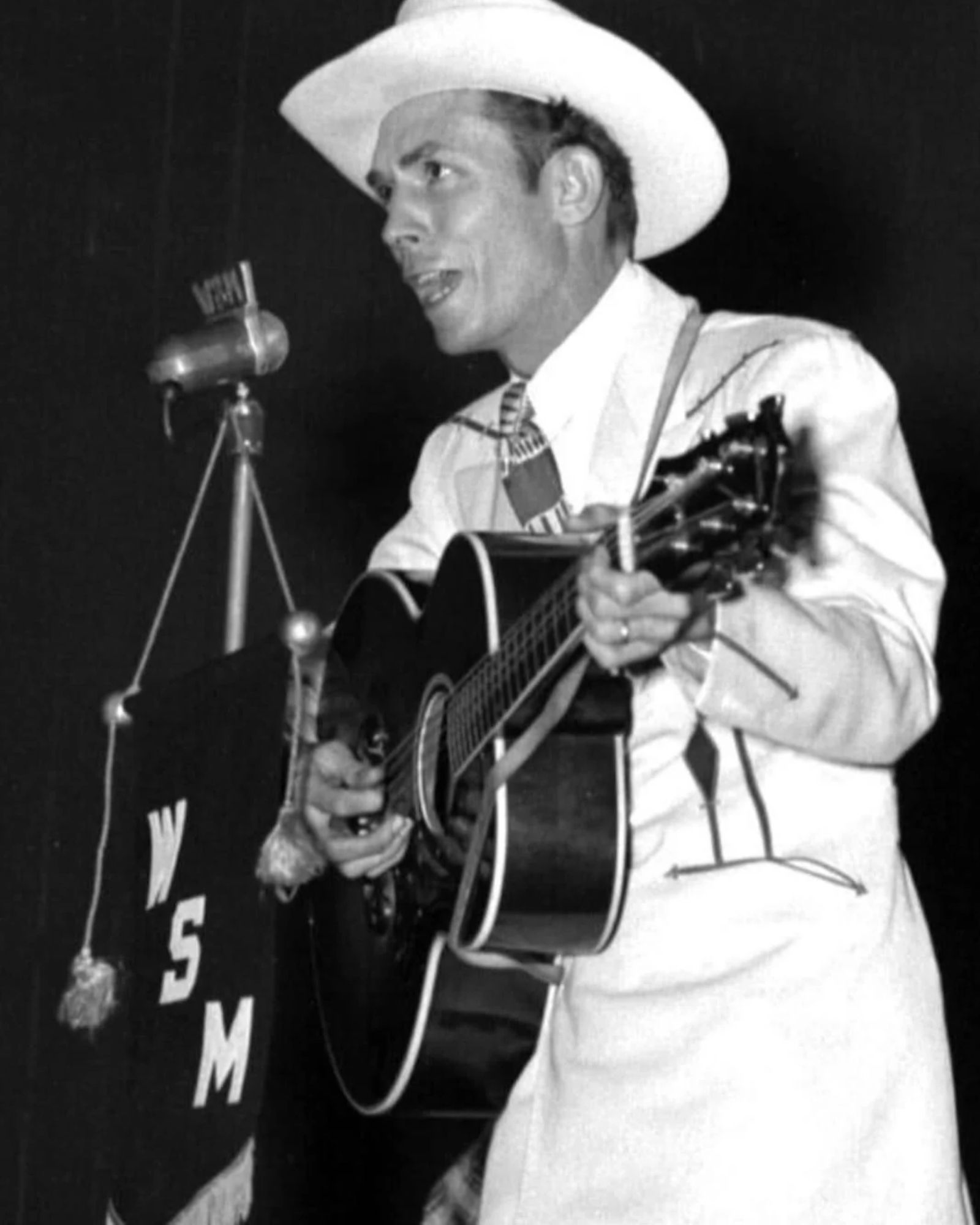
In the 1960s, during a move at Nashville’s WSM radio station, a collection of old recordings featuring Hank Williams was marked for disposal. They were not ordinary records. They contained performances that had been heard on the radio years earlier but had never been commercially released.
Most people had no reason to believe those old discs would become important again. Hank Williams had been dead for more than a decade, and the station no longer needed the recordings.
But a WSM photographer named Les Leverett noticed the discs among materials being discarded. Leverett asked permission to keep them, received approval, and took them home.
That decision helped preserve 72 radio programs featuring Hank Williams that might otherwise have disappeared permanently.
Why Hank Williams Made the Recordings in the First Place
In 1951, Hank Williams was one of country music’s biggest stars. The success of songs such as “Lovesick Blues” and “Cold, Cold Heart” had made Hank Williams increasingly popular, and the demand for live appearances kept growing.
At the same time, Hank Williams had a regular radio commitment at WSM in Nashville. Every weekday morning at 7:15, listeners could tune in to a 15-minute program sponsored by Mother’s Best Flour.
The broadcasts featured Hank Williams and the Drifting Cowboys performing country songs, gospel numbers, instrumentals, and advertisements for the sponsor’s products.
There was one practical problem. Hank Williams could not always be in Nashville because of touring commitments.
To keep the broadcasts running, Hank Williams and the band prerecorded programs on large, 16-inch acetate transcription discs. WSM could play those recordings on mornings when the musicians were away.
These discs were created for radio broadcasts, not for sale in record stores. Their usefulness was limited, and acetate recordings were vulnerable to wear and damage.
Once the programs had aired, there was little practical reason for WSM to preserve them indefinitely.
The Photographer Who Saved the Discs
Years later, WSM began moving its offices from downtown Nashville. During the move in the 1960s, old materials were cleared out, including the Mother’s Best recordings.
Les Leverett, who worked as a photographer for WSM and the Grand Ole Opry, discovered the acetate discs in or near a trash bin.
The circumstances were later documented in a Tennessee court case concerning ownership of the recordings. According to the court’s findings, Les Leverett requested permission to keep the discarded discs and was allowed to take them.
The recordings remained in private possession for years. On July 12, 1982, former Drifting Cowboys musician Hillous Butrum entered into an agreement to acquire the acetates from Les Leverett.
But preserving the physical discs was only part of the challenge. Making their contents available to the public would prove much more complicated.
A Legal Battle Over Hank Williams’ Forgotten Performances
By the 1990s, interest in releasing the recordings commercially had grown. In 1997, Legacy Entertainment Group acquired the acetate recordings through Hillous Butrum.
However, several parties disputed who possessed the rights to release Hank Williams’ original performances.
Polygram Records claimed rights through Hank Williams’ earlier recording agreements with MGM Records. Legacy Entertainment Group claimed rights through its acquisition of the discs. Hank Williams’ heirs argued that the rights to the original performances belonged to the estate.
The dispute eventually reached the Tennessee Court of Appeals.
On January 20, 2006, the court upheld the ruling that neither Polygram nor Legacy held the claimed commercial rights to the original radio performances. Those rights belonged to Hank Williams’ heirs.
The decision helped clear the way for a broader release of the historic broadcasts.
Restoring Recordings Never Intended to Last
There was still a major technical problem. The acetate discs had aged considerably, and their sound quality varied.
Fortunately, in 1981, Bob Pinson of the Country Music Hall of Fame had made preservation transfers of the recordings. Those copies became especially valuable because some original discs had deteriorated.
Audio engineer Joe Palmaccio later worked on restoring the surviving performances. The recordings contained clicks, crackling, distortion, and considerable surface noise. Some sections were so noisy that the unwanted sound competed with Hank Williams’ voice.
The restoration required careful work to remove damage without changing the character of the original performances. Palmaccio used multiple audio-processing techniques, treating different recordings according to their individual condition.
The objective was not to make the broadcasts sound like modern studio recordings. It was to preserve the original performances as faithfully as possible.
Seventy-Two Programs Finally Reached the Public
Selected Mother’s Best recordings appeared in commercial collections in 2008 and 2009. Then, in September 2010, Time Life released Hank Williams: The Complete Mother’s Best Recordings…Plus!
The collection contained 72 complete radio programs, featuring 143 Hank Williams performances, along with conversations and the original broadcast material. The deluxe edition included 15 audio CDs and a bonus DVD.
Listeners could hear familiar songs, gospel performances, traditional music, advertisements, and the spontaneous conversations that had accompanied the original programs.
Unlike carefully produced commercial records, these broadcasts preserved the atmosphere of a working country band performing for an early-morning radio audience.
And that is what makes their survival so remarkable.
The recordings were never intended to become a major historical collection. They were made to fill a short daily radio slot, stored after their immediate purpose had ended, and eventually designated for disposal.
Yet decades after Hank Williams’ death on January 1, 1953, the forgotten broadcasts became an important addition to the surviving record of one of country music’s most influential performers.
Seventy-two programs. One collection nearly discarded. And an extraordinary piece of country music history preserved because someone recognized the value of those old discs before they were lost.